

If you’re planning a kitchen or home remodel, you’ll eventually hear the terms framed and frameless cabinets. For many homeowners, the difference isn’t immediately clear—and the advice coming from showrooms, contractors, and online searches can feel inconsistent or confusing.
At Capozzi Design Build, this conversation isn’t new to us. Cabinetry has been part of our work—and our family history—for generations.
John Capozzi owned a cabinet shop and learned the trade through family, at a time when craftsmanship, tolerances, and longevity were non-negotiable. Long before frameless cabinetry gained attention in the U.S., we worked with it—while also designing and installing traditional framed cabinetry. That dual experience allows us to evaluate cabinetry as a system, not a trend.
In this article, we’ll explain the differences between framed and frameless cabinets clearly and honestly—where each excels, where each falls short, and how to determine which option is right for your home. There is no one-size-fits-all answer, and that’s exactly why this decision deserves thoughtful guidance.
Why many homeowners have never heard of frameless cabinetry
For most homeowners in the US, the manufacturers, showrooms, and installers default to framed (face-frame) cabinetry—not because it’s always better, but because it’s the American standard. In fact, nearly 99% of U.S. cabinet manufacturers produce framed cabinets. Likewise, most showrooms display it, most installers train on it, and most homeowners have lived with it their entire lives. As a result, many people have never encountered frameless cabinetry, let alone had it explained clearly.
Framed cabinetry became the standard because it:
-
It is more forgiving to install
-
Works well in homes with imperfect walls
-
Supports a wide range of installer skill levels
-
Aligns with traditional American kitchen styles
By contrast, frameless cabinetry requires tighter manufacturing tolerances and more precise installation. However, that doesn’t make it better—or worse, it simply explains why it’s less familiar and often misunderstood.
This is exactly why education matters.
What framed cabinets are (and the full range they cover)

Framed cabinets—also called face-frame cabinets—include a solid wood frame attached to the front of the cabinet box, with doors and drawers mounted to that frame.
What’s often overlooked is that framed cabinetry spans an extremely wide range of quality and cost.
Framed cabinets can include:
-
Budget-friendly, production-style cabinetry
-
Mid-range semi-custom cabinets
-
High-end, furniture-grade cabinetry
-
True inset cabinetry, which often represents the highest level of craftsmanship
In fact, well-built inset framed cabinetry is frequently more expensive than many frameless cabinet systems, due to the labor, precision, and detailing required.
Framed cabinetry excels when:
-
A very traditional aesthetic is the priority
-
Inset, partial overlay, or half overlay doors are desired
-
Furniture-style detailing and classic proportions matter
Framed cabinetry is not inherently “budget” or “premium.” Its value depends entirely on the cabinet line, construction quality, finish, and installation.
What frameless cabinets are (and where they excel)
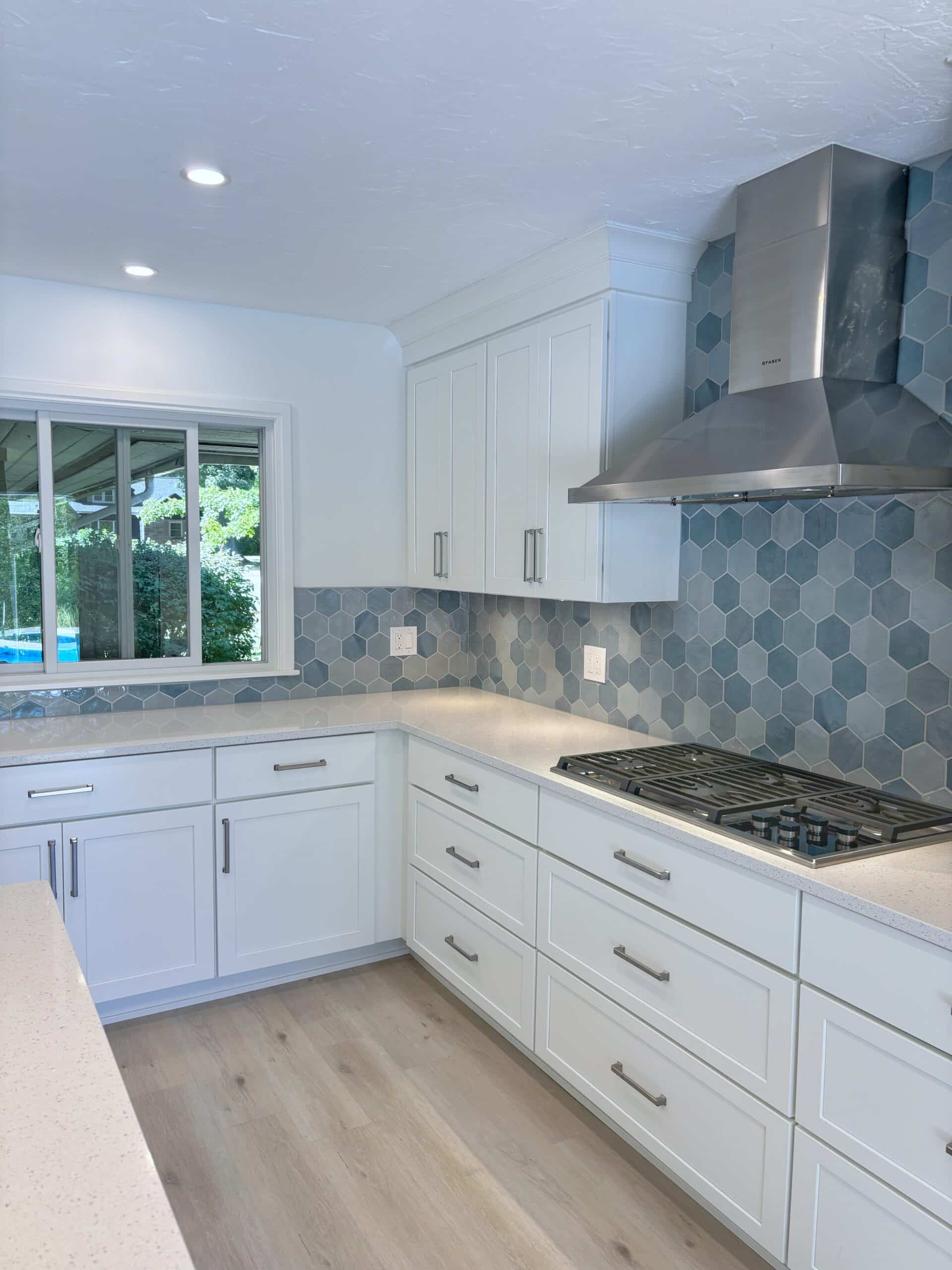
Frameless cabinets—sometimes referred to as European-style cabinets—do not include a face frame. Doors and drawers mount directly to the cabinet box.
Frameless cabinetry excels when:
-
Maximizing storage and accessibility matters
-
Cleaner lines and fewer visual breaks are preferred
-
A transitional or refined aesthetic is desired
While frameless cabinets are often assumed to be more expensive, that isn’t always the case. Depending on the manufacturer, frameless cabinetry can be very competitive with framed options when construction and finish quality are compared fairly.
Storage and accessibility differences
One of the most meaningful functional differences between framed and frameless cabinets is usable interior space.
Frameless cabinetry provides approximately 14% more usable storage within the same footprint. Wider drawer boxes, larger cabinet openings, and easier access are tangible benefits—especially in kitchens where storage efficiency matters.
That said, accessibility is also influenced by:
-
Stock vs. semi-custom vs. custom cabinet sizing
-
Interior drawer and storage configurations
-
Overall layout planning
Cabinet construction matters—but thoughtful design matters just as much.
A common misconception about frameless cabinet construction
Many homeowners assume frameless cabinets are inferior because they appear to use “less wood.” In reality, high-quality frameless cabinetry requires greater precision.
With frameless cabinetry:
-
The cabinet box itself is the structure
-
The box must be perfectly square and rigid
-
Manufacturing tolerances must be tight
-
Joinery and material quality matter significantly
In framed cabinetry, the face frame adds rigidity and can help compensate for minor variations in the cabinet box behind it. This doesn’t make framed cabinetry inferior—it reflects a different system with more forgiveness.
The key distinction isn’t which system is better, but how each system is built and installed.
Installation tolerances and skill requirements
Because frameless cabinetry relies entirely on the cabinet box for alignment, installation tolerances tighten significantly. Therefore, walls must be evaluated carefully, and cabinets must be installed level and square. Additionally, appliance panels, reveals, and drawer gaps should be coordinated in advance—not adjusted afterward. Consequently, this level of precision requires:
-
Experienced installers
-
Proper wall and floor preparation
-
Careful coordination with appliances, lighting, and finishes
Accordingly, our teams draw on extensive frameless installation experience to plan for precision and seasonal movement, so your cabinetry performs reliably over the long term.
Cost expectations (positioning, not pricing)
A common misconception is that framed cabinetry is always less expensive—or that frameless cabinetry is automatically higher-end.
Neither is true.
Cost is driven by:
-
The cabinet manufacturer
-
Box construction and materials
-
Joinery
-
Finish type and finish quality
-
Level of customization
-
Installation expertise
You can find budget framed cabinets, premium framed inset cabinetry, and frameless cabinetry that competes very well in the mid-range. The cabinet line—and the remodeler specifying it—determine value, not the construction type alone.
Which cabinet option is right for your home?
The right choice depends on:
-
Your layout and available space
-
How important is maximizing usable storage is
-
Your aesthetic goals
-
Your overall investment priorities
It also depends on factors beyond framed vs. frameless:
-
Cabinet box construction
-
Finish type and durability
-
Door style
-
Wood species vs. MDF vs. particle board
This is why we focus on education. Our role is to explain tradeoffs clearly so decisions aren’t made based on appearance alone—or advice from someone who understands cabinetry only at the surface level.
Honest questions homeowners ask
Is framed cabinetry cheaper than frameless cabinetry?
Not necessarily. Framed cabinetry ranges from budget production lines to high-end inset cabinetry that can exceed the cost of many frameless systems.
Is frameless cabinetry only for modern kitchens?
No. Frameless cabinetry works beautifully in transitional and clean traditional kitchens. This is one of the most common misconceptions we encounter.
Do you ever recommend framed cabinetry instead?
Yes—especially when a very traditional or inset look is the priority, or when budget constraints drive the best value decision.
Bringing it all together
Framed and frameless cabinets both have a place. The right choice comes from understanding how each system works—and aligning that understanding with how you live and what you value.
Schedule a planning session with our design-build team or call 440-247-9496 to speak with our team.
We’ll walk you through cabinetry options, explain the tradeoffs, and help you determine the best fit for your home and your investment.
You may also want to read our companion article: