

Mildew that keeps returning. Hairline cracks in the grout. A shower that suddenly starts leaking within the first few years.
These are some of the most common warning signs homeowners notice in a bathroom — and they often show up long before anyone realizes there may be a bigger issue behind the tile.
At first, it may seem cosmetic or just part of normal wear. But bathrooms deal with constant moisture, and when that moisture isn’t properly managed, small signs can turn into bigger problems affecting the subfloor, framing, and surrounding walls.
If you’re planning to invest $40,000 or more into a bathroom remodel, understanding what protects your bathroom beneath the surface matters just as much as choosing beautiful tile. The systems behind the tile — waterproofing, tile installation, and ventilation — are what truly determine whether your bathroom stays clean, dry, and durable for years to come.
At Capozzi Design Build, we work with Northeast Ohio homeowners who don’t want a bathroom that looks good for a few years — they want one that performs for decades. Not just until the warranty runs out. Not just until the grout needs refreshing. But long after the final walkthrough is forgotten.
In our climate — with freeze-thaw cycles, attic duct runs, and older framing — durability isn’t accidental. It’s engineered. And it depends on three systems working together: tile, waterproofing, and ventilation.
By the end of this article, you’ll know exactly what protects a bathroom from moisture failure in Northeast Ohio — and how to spot red flags before signing a remodeling contract.
You’ll learn:
- Why tile alone is never the thing keeping water out
- How proper waterproofing is planned before finishes are chosen
- What effective bathroom ventilation really looks like (and what almost always goes wrong)
Whether you’re planning a remodel now or just trying to understand what you already have, this guide will help you spot risks early, ask better questions, and protect both your home and your remodel budget—without scare tactics or sales pressure.
Why Bathroom Waterproofing and Ventilation Matter in Northeast Ohio
In Northeast Ohio’s climate, moisture control isn’t optional — it’s the difference between a bathroom that lasts decades and one that quietly deteriorates behind the walls.
You might choose tile for its beauty and durability — but tile itself is not waterproof. Grout and stone can wick moisture. Steam drives water into framing if the wrong backer or membrane is used. Add freeze–thaw cycles, older homes, and attic duct runs, and small misses turn into soft subfloors, peeling paint, and musty closets.
If you’re told the solution is ‘just more caulk,’ that’s a red flag. What your bathroom actually needs is a coordinated system.
- Tile selected and installed for the space (including slip resistance and movement joints).
- Waterproofing that’s continuous, correctly sloped, and tested before tile goes on.
- Ventilation that actually evacuates moisture to the exterior—quietly and reliably.
That’s the backbone of a bathroom built to last. It’s also the kind of detail-first planning our design–build team is known for, from site protection and HEPA dust control to permitting and sequencing.
How Professional Bathroom Waterproofing Is Planned (So Nothing Critical Gets “Handled Later”)
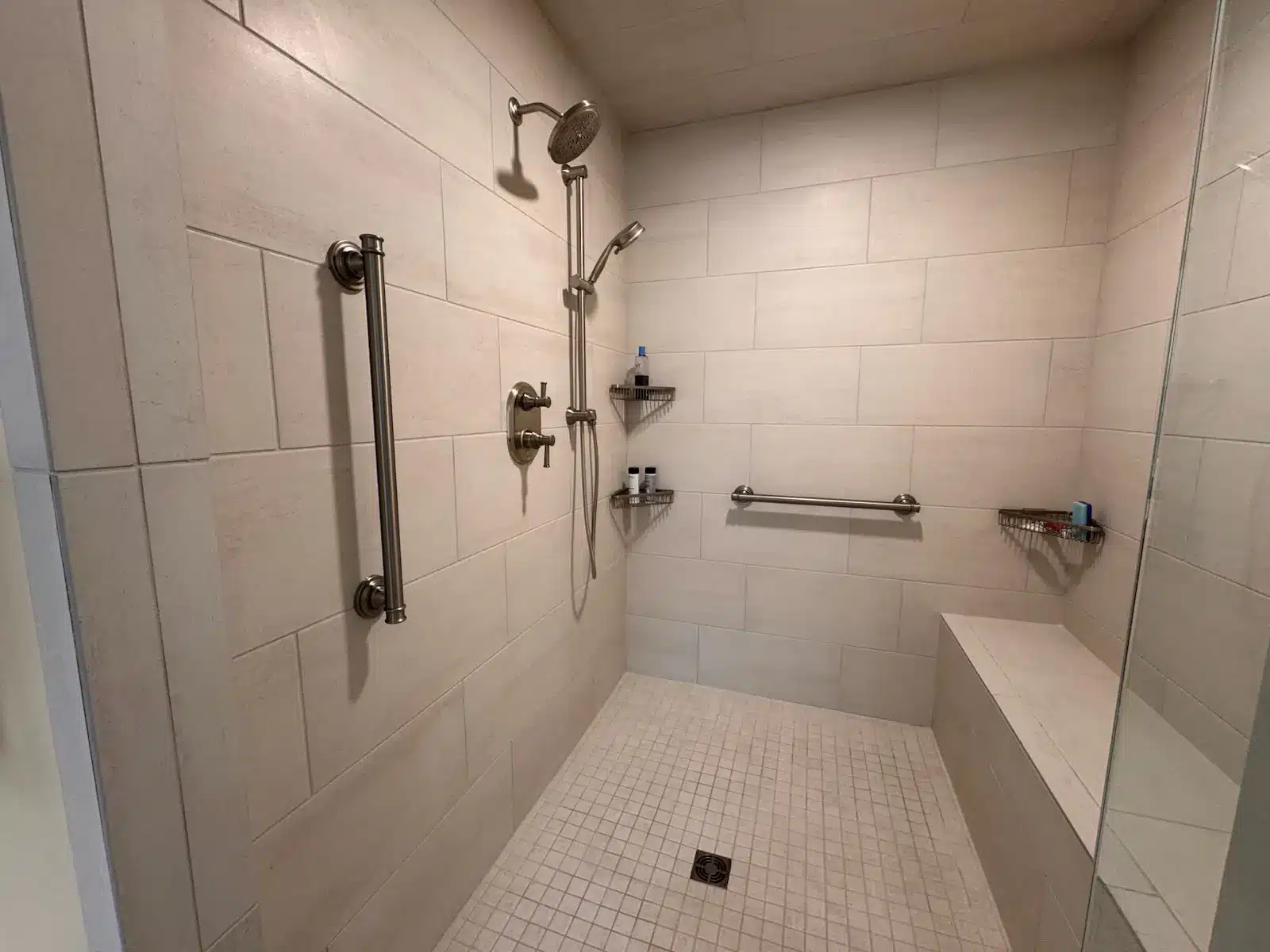
Waterproofing must be designed as a complete system — not improvised once installation begins.
What goes wrong when this is skipped: We often see showers where tile and grout look intact, but water migrates through seams, niches, or valve penetrations because the waterproofing was pieced together—or chosen after the layout was already set.
The result is hidden moisture damage that doesn’t show up until finishes are failing.
In a well-managed remodel, waterproofing is planned and documented before tile is ever selected — so you’re never making finish decisions on top of an undefined system.
Curbless showers require structural and drainage planning from day one. In our projects, that engineering happens before finishes are selected — not after demolition begins.
In a well-run project, accountability is clear: one team owns the waterproofing plan, installation, and verification—because water doesn’t care whose subcontractor “was supposed to do that.” (It’s ruthless like that.)
Why Proper Shower Prep Is Critical for Bathroom Waterproofing
No amount of premium waterproofing can compensate for improper slope or structural issues beneath the tile.
What goes wrong when this is skipped: Without proper prep, water can pool instead of draining. Over time, that standing moisture can work its way into subfloors, leading to soft spots, loose tile, and repairs that require tearing out finished surfaces.
Even the best waterproofing system won’t protect your bathroom if the structure and shower base underneath aren’t properly prepared. We’ve opened showers that looked flawless on the surface, only to find saturated subflooring and deteriorating framing underneath after just a few years. From the outside, everything appeared fine—until it wasn’t.
This is where a professional team earns its keep: we verify the underlying conditions are correct to manufacturer and industry standards, then we test before finishes go in. We flood test the pan—because a 24-hour test is cheaper than a 24-month leak.

Why Bathroom Waterproofing Must Extend Beyond the Shower
Water doesn’t stop at the glass — and your waterproofing strategy shouldn’t either.
What goes wrong when this is skipped: Water doesn’t stay neatly inside glass panels. We regularly find damage at curbs, toilet areas, and just outside showers where waterproofing stopped too soon—especially in kids’ baths and guest bathrooms with heavier use.
In Northeast Ohio homes, we frequently see moisture damage where waterproofing stops just beyond the shower footprint. In a well-planned remodel, the scope clearly defines where protection begins and ends—especially at curbs, thresholds, seats, window returns, and niches. In higher-use baths, we often extend protection beyond the shower zone to reduce long-term risk.
Bathroom Ventilation That Properly Removes Moisture
A bathroom fan that doesn’t properly exhaust to the exterior is simply relocating moisture — not removing it.
What goes wrong when this is skipped: Undersized or poorly ducted fans often move steam into attics instead of outdoors. In Northeast Ohio homes, that trapped moisture can contribute to mold, peeling paint, and insulation damage long before anyone connects it back to the bathroom.
In your bathroom, a properly sized fan that exhausts fully to the exterior isn’t optional — it’s essential.
In colder Northeast Ohio winters, poorly terminated ducts can also contribute to condensation buildup inside attic spaces. In our climate, we design ventilation systems that continue clearing moisture long after you leave the room — so steam doesn’t linger in walls or attic spaces.
Bathroom Maintenance Tips to Prevent Moisture Damage
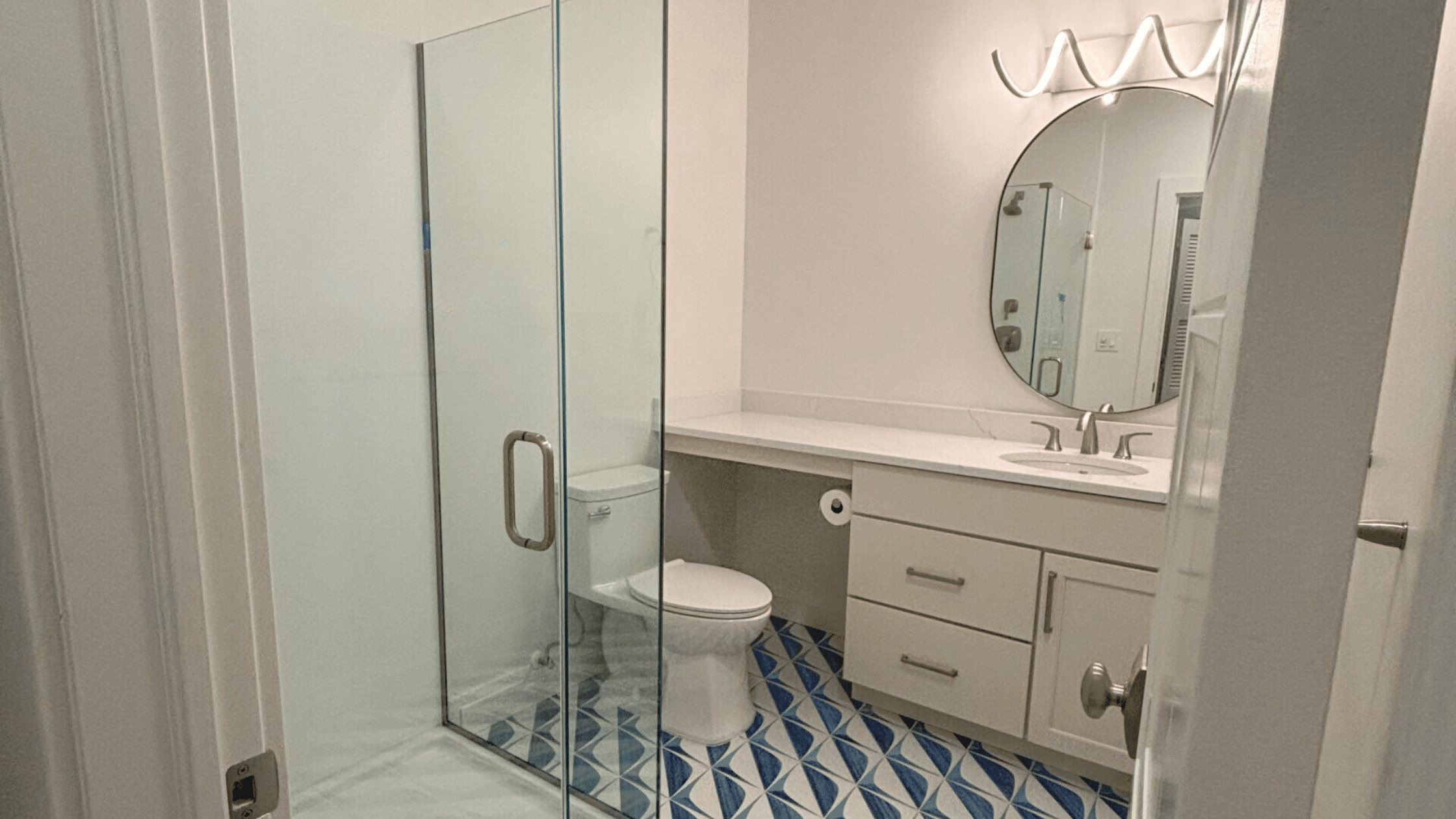
Even a well-built bathroom performs best when small maintenance signals are addressed before they become structural problems.
After your remodel is complete, a few simple habits will help your finishes last: the fan should run until all moisture is removed, and 30 minutes is a simple guideline. Be sure to wipe down the shower glass to reduce soap film and moisture dwell time.
If you notice recurring caulk separation or cracking grout, treat it as a signal—not a cosmetic nuisance. It may indicate movement, substrate issues, or moisture that deserves a professional look before surface fixes.
Why One Accountable Team Protects Your Bathroom Investment
When tile, waterproofing, and ventilation aren’t coordinated by one accountable team, performance gaps are almost inevitable.
From layout and product selections to on-site protection and inspections, a single design–build team keeps tile, waterproofing, and ventilation aligned—and your project on schedule. It’s exactly why our clients choose a streamlined, one-team approach.
Signs Your Bathroom Waterproofing Is Failing
Moisture failures rarely start dramatically — they begin with small, repeatable warning signs that deserve attention.
If your bathroom waterproofing begins to fail, it rarely starts with a dramatic leak. More often, it begins with subtle warning signs that are easy to dismiss — until the repair becomes far more involved.
Here’s what to watch for:
Recurring Cracked Grout
Hairline grout cracks can happen occasionally due to normal settling. But if cracks keep reappearing in the same areas — especially near corners, curbs, or around niches — it may indicate movement in the substrate or moisture affecting the assembly underneath. Grout is not a waterproof barrier. When it repeatedly fails, it’s often pointing to a deeper issue.
Caulk Separation at Corners
Flexible caulk joints at inside corners, where walls meet the floor, or where tile meets a tub, should remain intact. If you notice recurring gaps or pulling away, it may signal structural movement, improper joint spacing, or moisture cycling behind the tile. Re-caulking may temporarily improve appearance, but repeated separation deserves closer evaluation.
Persistent Humidity After Showers
If mirrors, walls, and ceilings stay damp long after a shower — even with the fan running — ventilation may be undersized, poorly ducted, or not exhausting fully to the exterior. In Northeast Ohio, especially during colder months, lingering moisture can migrate into attic spaces and wall cavities before anyone notices visible damage.
Soft Spots in the Flooring
When you walk across your bathroom floor, the tile should feel solid underfoot. Any flexing, sponginess, or hollow-sounding areas could indicate water intrusion into the subfloor. This is one of the more advanced warning signs and should be assessed promptly before structural deterioration spreads.
Peeling Paint Near the Ceiling
Paint failure near the ceiling or above the shower can indicate chronic humidity levels that exceed what the room is designed to handle. While it may look cosmetic, peeling paint often reflects long-term moisture exposure that ventilation isn’t managing effectively.
If you notice one of these signs, it doesn’t automatically mean your bathroom needs a full renovation. But it does mean the underlying moisture management system deserves a closer look — especially before small symptoms become structural repairs.
Bathroom Waterproofing Mistakes That Lead to Costly Repairs
Most expensive bathroom repairs stem from shortcuts taken before the first tile was ever set.
- If you’re relying on grout as your waterproof layer, your bathroom is vulnerable. Grout is not your moisture barrier—membranes are.
- If your priority is the lowest upfront price, these moisture-control upgrades may not align with your goals.
- Venting into the attic. This traps moisture where it can quietly damage roof decking and insulation.
- Ignoring early warning signs. Small moisture issues can escalate into structural repairs and mold remediation that exceed five figures—often costing more than doing the work correctly the first time.
- A professional team floods, tests, and documents the shower pan before tile is installed. If that step isn’t part of the plan, that’s a concern.
- System compatibility: A professional team uses systems designed to work together — and stands behind the full assembly.
- If you underestimate the total investment required for proper waterproofing and ventilation, you may face costly compromises mid-project. In our region, a quality hall bath “pull-and-replace” commonly starts around the upper -$30Ks, while primary suites scale higher with custom layout changes, tile coverage, and features. Right-sizing the budget to the outcome prevents mid-project compromises.
The goal isn’t to spend more. It’s to align the budget with the level of performance you expect—and avoid mid-project compromises that affect long-term durability.
What Does Proper Bathroom Waterproofing and Ventilation Cost in Northeast Ohio?
In Northeast Ohio, the cost of a bathroom remodel varies widely based on layout changes, tile coverage, and product selections. But one factor that consistently influences long-term performance — and long-term cost — is how waterproofing and ventilation are handled.
For a straightforward hall bathroom remodel where the layout remains the same, investment often begins in the upper -$30,000s. Primary suites with structural changes, curbless showers, expanded tile coverage, and upgraded ventilation systems can scale significantly higher.
If you’re investing in a bathroom remodel, here’s what’s important to understand: proper waterproofing and ventilation are not line items you “value engineer” without consequences.
Continuous membrane systems, flood testing, upgraded subfloor preparation, humidity-sensing fans, and properly ducted exterior venting add cost upfront — but they prevent exponentially larger repair costs later.
When moisture control is underbuilt, repairs often involve:
- Demolition of finished tile
- Subfloor or framing replacement
- Mold remediation
- Reinstallation of new materials
In many cases, corrective work exceeds five figures — sometimes approaching the cost of the original remodel.
Your goal isn’t to spend more. It’s to invest wisely in performance you won’t have to redo. In most cases, the difference between “looks good” and “built to last” is a relatively small percentage of the overall project. But it makes a dramatic difference in long-term performance.
When proposals are vague about these details, that’s worth slowing down the conversation. Because in remodeling, the most expensive problems are usually the ones you can’t see.

Pro Bathroom Planning Tips for Long-Term Durability
The smartest bathroom upgrades are the ones that quietly protect comfort, safety, and resale value for years to come.
- Think living-in-place now. Even if you don’t need it yet, plan blocking for future grab bars, choose slip-resistant tile, consider a curbless or low-threshold shower, and select lever handles. These are smart, invisible upgrades that serve everyone. (Our team holds Certified Aging in Place and Certified Living in Place credentials.)
- Protect your home during construction. Expect dust containment, HEPA filtration, and daily site cleanup—comfort during the project is part of quality.
- Insist on clarity before you sign. Ask for real layouts, real materials, and real numbers—not placeholder allowances. That’s the heart of our Clarity & Confidence Method, built to avoid surprises and future-proof your investment.
How Capozzi Design Build Protects Your Bathroom Investment
A bathroom that lasts isn’t defined by how it looks on day one—it’s defined by how well it manages moisture every day after.
Tile, waterproofing, and ventilation are not separate upgrades — they’re a single system, and when one is treated as an afterthought, performance gaps are almost inevitable.
If you started reading because something felt “off”—a damp room, cracking grout, or uncertainty about how your bathroom was built—now you know what to look for and why those details matter, especially in Northeast Ohio homes. Your goal doesn’t have to be perfection — it has to be informed decisions that protect your home and your investment for decades.
If you’re planning a remodel and want clarity before committing, your next step is to explore how a well-planned bathroom remodel actually comes together—from layout and material selections to sequencing and accountability.
For a straightforward hall bathroom remodel, our bathroom remodeling overview walks you through the process from start to finish, so you can see what thoughtful planning really looks like before making any commitments.
The best time to address moisture risk is before the tile is ordered and the ductwork is installed. If you’re considering a remodel, starting with a structured design conversation can prevent costly course corrections later.
At Capozzi Design Build, our team coordinates every detail—from structure and waterproofing to ventilation and finishes—so nothing critical gets missed. If you want a bathroom that’s beautiful, durable, and built with intention, call 440-247-9496 or reach out to schedule a design conversation.